Do Some Ethnicities Have Larger Babies Than Others
The nation's racial and ethnic minority groups—especially Hispanics—are growing more than rapidly than the not-Hispanic white population, fueled by both immigration and births. This trend has been taking place for decades, and one result is the Census Agency'south declaration today that not-Hispanic whites now account for a minority of births in the U.Due south. for the first time.
The agency reported that minorities—defined as anyone who is not a unmarried-race non-Hispanic white—fabricated up 50.4% of the nation's population younger than age i on July ane, 2011. Members of minority groups account for 49.7% of children younger than age five, the bureau said, and for 36.6% of the total population. The findings are included in the bureau'southward first fix of national population estimates since the 2010 Demography, when 49.5% of babies under age 1 were minorities.
 Hispanics are more than a quarter of the nation'due south youngest residents, according to the new population estimates, accounting for 26.3% of the population younger than age one. Among other major non-Hispanic groups, the share for whites is 49.6%; for blacks, 13.7%; and for Asians 4.4%.
The long-term result of these changes amongst younger age groups is that not-Hispanic whites are projected to go a minority of the population (47%) by 2050, according to Pew Inquiry Center population projections. (Demography Bureau projections say the change will occur in 2042). Hispanics, already the nation's largest minority grouping, are projected to continue to account for nigh population growth by that yr.
Population Patterns
Underlying these changes is the rapid growth of minority groups compared with non-Hispanic whites. Results from the 2010 Demography showed that racial and ethnic minorities accounted for 91.7% of the nation'southward growth since 2000. Most of that increase from 2000 to 2010—56%—was due to Hispanics. Non-Hispanic whites, though still a majority of the nation's population, accounted for simply eight.three% of its growth over the decade.
Minorities deemed for 93.3% of the nation's population growth from April 1, 2010 (Demography 24-hour interval) to July 1, 2011, co-ordinate to Census Agency data released today. Of the total population growth of ii.8 million during that period, the total increment for non-Hispanic whites was only 192,000.
Another important part of the explanation for changing birth patterns is that minority populations are younger than whites, so are more likely to be having and raising children. At that place are notable differences past race and indigenous grouping in median age, the historic period at which half a group is younger and half older. The national median historic period in 2011 was 37.iii.
Non-Hispanic whites have the oldest median age, 42.3, in 2011, according to the population estimates. Hispanics have the youngest, 27.vi. Non-Hispanic blacks (32.9) and non-Hispanic Asians (35.9) also are younger than whites.
Related to their younger age profiles, racial and ethnic minority groups also include a higher share of women in the prime child-bearing ages of 20-34. Fully a quarter (25%) of the nation's Hispanic women are in this historic period grouping, according to the population estimates, compared with fewer than 1-in-five non-Hispanic whites (19%). For non-Hispanic blacks and Asians, the share is 22%.
Fertility
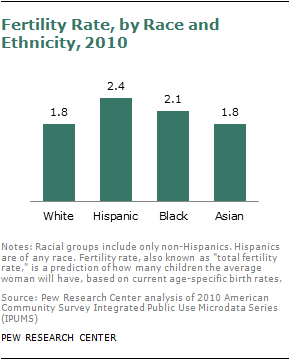
The changing profile of the nation'due south youngest residents too stems from the fact that some groups, peculiarly Hispanics, have college numbers of children than exercise non-Hispanic whites. One illustration of this difference is in the "total fertility rate," or the number of children the boilerplate adult female is predicted to have in her lifetime, based on current age-specific nascency rates. For the U.Southward. every bit a whole, co-ordinate to a Pew Research Heart assay of American Community Survey data, the number is 2.0. (American Community Survey data in this posting come from a Pew Research Middle analysis of the 1% sample of the 2010 ACS Integrated Public Use Microdata Series [IPUMS])
Among Hispanics, the total fertility rate is two.four. For non-Hispanic whites and for non-Hispanic Asians, it is 1.8. Non-Hispanic blacks (two.i) accept higher fertility than whites only lower fertility than Hispanics.
Immigration is an of import contributor to higher birth rates among Hispanics, because foreign-born women tend to take more children on average than U.Due south.-built-in women. Nearly growth in the Hispanic population from 2000 to 2010 was due to births, not clearing, a alter from the long-time design. Only most births to Hispanic women are to those born outside the U.S.
Interracial Relationships
Social modify, not just demographic modify, as well is driving recent birth rate trends. A rising number of multiracial babies is being built-in to couples that include one white parent.
Rising rates of intermarriage explain some of the trend. Among newlyweds in 2010, nine% of whites married someone who was Hispanic or of some other race. That was nearly triple the rate in 1980. In a 2009 Pew Research Center survey, 29% of whites said they accept an immediate family member or shut relative married to someone of a unlike race; this compares with 50% of nonwhites who said the same.
Survey data indicate that the public increasingly accepts and approves of intermarriage and interracial dating.
Demography Bureau Methodology
The Census Bureau estimates released today are not the nation's official birth numbers, which come from the National Heart for Health Statistics (NCHS). The latest concluding NCHS birth data that is available is for 2009. As the Demography Bureau explains in its estimates methodology, it calculated the share of births for the nation'southward race and ethnic groups based on 2009 data from the NCHS, forth with some more current data from individual states.
Because there are differences in the race categories used by the NCHS and Census Bureau, the Demography Agency adjusted the NCHS information to be consistent with its own categories. The agency calculated origin-specific birth rates for 2009 using its own population estimates for that year, so applied them to the estimated 2011 adult population to obtain its results.
Demographics of Motherhood
Although the Census Bureau study does not provide data on demographic characteristics of mothers, a Pew Inquiry Center report based on other information shows that there are marked differences in historic period, pedagogy and marital status among mothers of different racial and indigenous groups.
Among black and Hispanic mothers, births peak among women in their early 20s. For white and Asian mothers, births tiptop amongst women in their late 20s and early 30s. Looking at educational attainment differences among groups, virtually white and Asian mothers are higher educated, while most Hispanic and black mothers are not.
In 2009, according to the National Middle for Health Statistics, 41% of births were to unmarried mothers, merely the shares varied for dissimilar groups: 53% for Hispanics, 29% for not-Hispanic whites and 73% for not-Hispanic blacks.
Source: https://www.pewresearch.org/social-trends/2012/05/17/explaining-why-minority-births-now-outnumber-white-births/
0 Response to "Do Some Ethnicities Have Larger Babies Than Others"
Post a Comment