What Is the Easiest Architecture Software to Use
Michael LaValley is an NY-state registered architect, career strategist and blogging entrepreneur. His blog, Evolving Architect, helps creative professionals to aqueduct their passion for compages into successful careers.
"I think information technology's off-white to say that personal computers have go the most empowering tool we've ever created. They're tools of communication, they're tools of creativity, and they can be shaped by their user." — Bill Gates
Finding Your Workflow
When I recollect of all the late nights trying to piece of work on a project here or there, the one thing I'thousand grateful for is that I take created a workflow that, well, works for me. Every bit a designer, there are countless different software packages you can use to realize your concept. The trick is agreement what software works for yous both from an individual plan level and from an overall workflow.
If you're actually practiced at using a software plan, but it doesn't aid y'all become straight from concept to production, something'southward incorrect. Hopefully past sharing my own workflow here, you can begin to understand a bit more virtually how I piece of work and employ my strategies as a precedent for your own way of working. I've kept the order of how I discuss the programs below in order of my typical workflow.
My Personal Software Workflow
Sketching — Concepts
AutoCAD — Drafting
SketchUp — Modeling
VRay — Rendering
Photoshop — Editing
InDesign — Layout

The Procreate app on iOS; via Akers Architectural Rendering (on YouTube)
ane. Sketching
OK, OK, I know. Sketching is a process, not a program. I get it. But the thing you need to sympathise first and foremost is simply "What am I making?" Y'all can spend hundreds of wasted hours tinkering on a computer cartoon, model or final layout but to realize that what you lot're making is zilch like you intended — in a very bad way. Don't brand that mistake. Information technology's non easy to recover from.
Instead, just sketch out a few ideas. See what happens. Let's say you're creating a edifice — What are the site restraints? What will the overall shape of the building be? How tall will it exist? How many stories? Now, I've tried a few sketching programs with my iPad before. Even so, I've never had nigh as much luck with sketching as I have with but a piece of newspaper and a marker pen or pencil. It'south simple, information technology's piece of cake, and anyone tin do it.
If you're in the market for a sketch app, though, the best one I institute by far was Procreate. It has a friendly user interface and a slap-up library of brushes and has been constantly updated since it was released.
A word of caution: There are tablet apps out at that place that create dimensional drawings and use similar interfaces to drafting software. At this stage in your design's development, do Non use these apps. You lot'll be trapping your work into something that is definitive and 'hard' rather than conceptual and 'soft.' Y'all need your initial thoughts to be clear, concise, but malleable. If you go the other route, you might just find that y'all're worried more than about the software than the design (trust me, I know). I'm a bit partial to sketching notes to myself in a sketchbook or on small-scale notepads, but as long every bit you sketch somewhere before moving to the computer, you should be able to work out a lot of the problems you can avoid afterward.

Via Autodesk
2. AutoCAD
This is in some means the almost useful software program there is. I've been able to create fantastic drawings and presentations from this alone simply past manipulating and controlling line weights layout and print settings. The get-go thing you lot need to practice is adjust the user interface to your liking. Have a look around and adjust the screen and your tools as necessary. Brand sure that yous have the bones drawing tools, manipulation tools (motion, array, etc.) and layer tools at your disposal.
From a sketch, I'll take the concept into AutoCAD and transpose the ideas as best I can into a hard lined drawing. It's in this stage that the inevitable realities come to light in the design. Maybe the sketch was a fleck besides generous in relation to the overall size of the edifice. Maybe the grid I had initially intended doesn't really work over the entire site. AutoCAD is the tool that will assistance you test some of your ideas. The trick is to stay organized with your layers, sheets and other drawing conventions. Every bit soon as you lot begin to deviate from the initial standards you've created, the drawings y'all create will go muddied and aggravating for y'all later.
When utilized properly, though, AutoCAD will provide you lot with a two-dimensional cartoon that you tin can either manipulate further in a presentation plan such as Adobe Photoshop or Adobe InDesign, or y'all tin can export information technology to a 3D software package such as SketchUp.
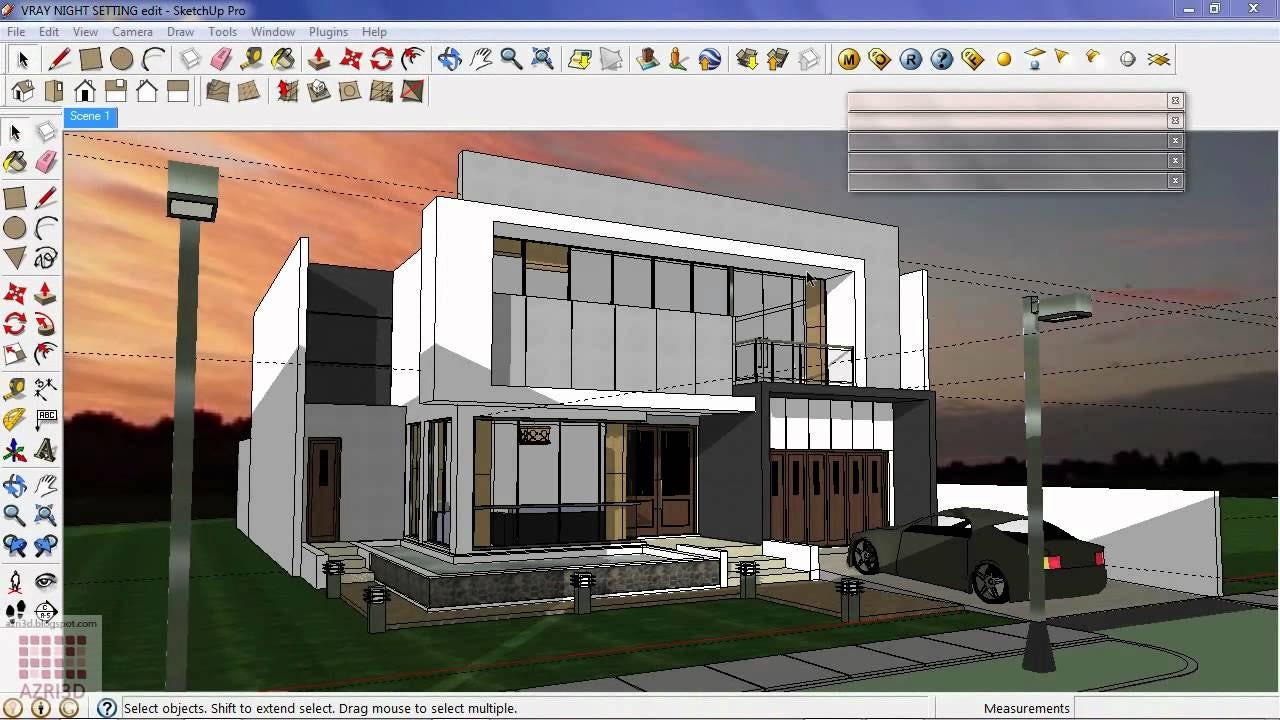
Via Azri3d Tutorial (on YouTube)
3. SketchUp
Is SketchUp the greatest 3D software program out there? Well, yep and no actually. It'south probably the easiest program to sympathise, interface with and larn. But you lot won't find SketchUp (without very advanced plug-ins) creating algorithmic, amoebic models in the same way that a Rhinoceros, 3DS Max or Maya might. And that's perfectly OK.
SketchUp is best used when yous have a 2D drawing to work from. From that point, yous tin can extrude shapes and quickly realize a 3D representation of that cartoon. The simplicity of SketchUp is its truthful strength. It's learning curve is much shallower because of information technology. The result is a much quicker path from knowing almost nothing about 3D programs to generating a total-fledged model in no fourth dimension.

Via Randi Isk
4. VRay
SketchUp has very real limitations when it comes to rendering. The only image SketchUp can export is basically a screenshot of your model as is. And unless yous want to spend 100 hours retooling each image in Adobe Photoshop (I certain as hell don't), yous may want to find a plug-in that tin be integrated direct into your workflow. EnterVRay.
VRay is a powerful plug-in that basically has the capability to turn SketchUp into a rendering powerhouse. While it's non exclusive to SketchUp (y'all tin basically integrate it into about all of the major 3D packages), it will definitely benefit SketchUp the nigh if you don't want to spend thousands of dollars trying to acquire some of the bigger names in 3D.
You lot can create lights and add realistic textures to the model in ways that allow y'all to keep working nearly the aforementioned style as you lot manipulate the model and then basically button a button when you're ready to render the scene. Now, it'southward not THAT elementary, only in my experience, it'south definitely one of the easier packages to manipulate without being an advanced 3D modeler. From in that location, yous can bring your raw rendering (an image before additional software manipulation) to such a program as Photoshop.

Via Pinterest
5. Photoshop
I think of Photoshopas the magic program of them all. It has the power to hide or show any you want it to. It tin can manipulate literally every pixel in your prototype, finer creating an entirely new image birthday if that was your want. But exist wary. If y'all're non careful almost how you set upward your file, you could lose everything and take to start over.
All the same, Photoshop won't leave y'all in a lurch if you don't want it to. Its system of layers is very straightforward but provides a broad variety of additional functionality if you're looking for more advanced image manipulation.
I personally utilize Photoshop with a file construction that allows me nondestructive formatting. This means that if you ready your layering management properly, y'all tin can utilize boosted layers to carry all of the changes while your original paradigm remains unscathed. The adjacent time yous utilize Photoshop, I suggest you consider all of the means yous can 'build up' the image rather than 'tear down' what y'all've already created.

Via Architectural Student
vi. InDesign
Dissimilar Photoshop, InDesign is intended purely every bit a layout plan. This doesn't mean that you can't dispense objects, simply rather that y'all take other programs that do information technology amend. As you create your own workflow, make certain that each program has a fundamental purpose. Once that purpose has been served, move on to the next until the product yous're creating is complete. InDesign is meant to arrange objects into presentable forms. These objects can vary from text boxes to shapes and images.
You can't take the final rendering from Photoshop that you've created and place it onto a sheet complete with title cake, project information, additional notes, etc., until you experience that the production is presentable. I have personally used InDesign for document creation, including my own résumés and portfolios. I have been able to make entire books by creating folio templates that tin be associated and copied around. It is truly a powerful tool that can put the finishing touches on your own piece of work.

Via V3wall
Why Employ a Program Workflow?
Then y'all may be asking yourself, "OK, these programs are groovy, merely why do I need to have a standardized workflow?" In my ain experience, the advantages of workflow come down to three cardinal principles: efficiency, consistency and ease.
Efficiency
Have yous ever tried to just to just 'wing it' when you lot're working on a design projection? I wouldn't advise information technology. One of the benefits of having a workflow you can count on is efficiency. If you're efficient in your work, yous can spend other time doing other things. At present, what you cull to do with your extra time is up to you; it's non up to the project you're working on. You could become for a walk, spend time with friends or even put that time dorsum into your project for something else y'all meant to go to.
In any case, having a workflow cuts downwardly on the time that you would otherwise be spending trying to figure out the best fashion to exercise something. I won't lie, finding your personal workflow is catchy, but if you lot continue it to the simple functions you need — drafting, modeling, rendering, editing, layouts and then on — you should be able to observe some combination of software that both suits your needs and gives you the structure yous demand to succeed.
Consistency
Another workflow benefit you'll gain is consistency. When you're consistent with a job, you're more than probable to do information technology and ultimately practise it well. Over fourth dimension, you'll build upwardly a way of working that teaches you advanced techniques. As you lot go better, you'll naturally want to know more about the plan you're working with in order to test its limits and empathize exactly what it tin do for y'all.
With consistency comes positive development of your project. You can nigh run on autopilot for the tasks that you need to exercise every time. Consistency volition inform your efficiency and create synergies between the programs you use. For instance, if you've done a job a hundred times, y'all're probably familiar with every aspect of it. Yous might even be able to recite the instructions by heart to someone who's never performed the same task. This ability — garnered from direct experience — will make yous more proficient, and it will practise so in a much shorter time than if you bounced effectually from program to plan without a articulate direction.
Ease
Every bit y'all get better at creating and harnessing the benefits from your workflow, you'll beginning to notice something profound. It gets much easier. You work best when yous discover your own groove, and the piece of work is well-nigh enjoyable when you don't have to worry about how to do something, y'all just know. This procedure will give you confidence in how y'all're working, which will in turn give yous confidence in what yous're doing, likewise.
You'll probable bask what you're doing more considering information technology comes easy to yous at present. No longer will you exist searching for the issue in online help chats; you'll just know the answer yourself and be able to teach others. I hope you enjoy what y'all practise. If annihilation, you should make the procedure yous go through easier and then that, at the end of the day, it'southward simply as enjoyable as when you start started. If it is, you'll get more done and the products you'll finish upwardly with volition be that much better for it.
Via Fuse Technology Group
Merely Remember …
The workflow I've outlined above is mine because information technology works for me specifically. There'due south zero wrong if you deviate from this list. In fact, I hope you'll begin by trying lots of different programs. You'll immediately detect what your skill level is by testing them out and understand roughly how difficult information technology will exist to utilize them in your ain workflow. Equally you begin to explore each software package, I propose you look at things like what formats the programs import/export in, the guess cost of each program and the overall learning curve.
Bold you're not still a pro at all of the programs, you could begin with the one yous know all-time and work your mode out from there — adding programs equally you get. Workflows create positive synergies in your process. Inherently understanding how each plan can piece of work with the next will dramatically increase your efficiency, make y'all much more adept in each software overall and let you to be more than confident in your twenty-four hours-to-day work.
Enjoy this article? Bank check out more of our Young Architect Guides:
The vii Secrets to Happy Interning
seven Tips for Getting Hired After Graduation
Edifice Great Architecture Models
Architectural Redlines
five Lies Told Most the Profession Y'all Must Ignore
How to Convince Your Audience With a Powerful Project Narrative
How to Write About Compages
5 Specifying Tips for Outset-Time Architects
Architizer is harnessing the latest technology to create a meliorate way for architects to research building-products.Sign up today and discover everything y'all need to create amazing architecture.
Cover image via Fuse Applied science Group
Source: https://architizer.com/blog/practice/details/the-6-design-programs-i-use-most-and-why/
0 Response to "What Is the Easiest Architecture Software to Use"
Post a Comment